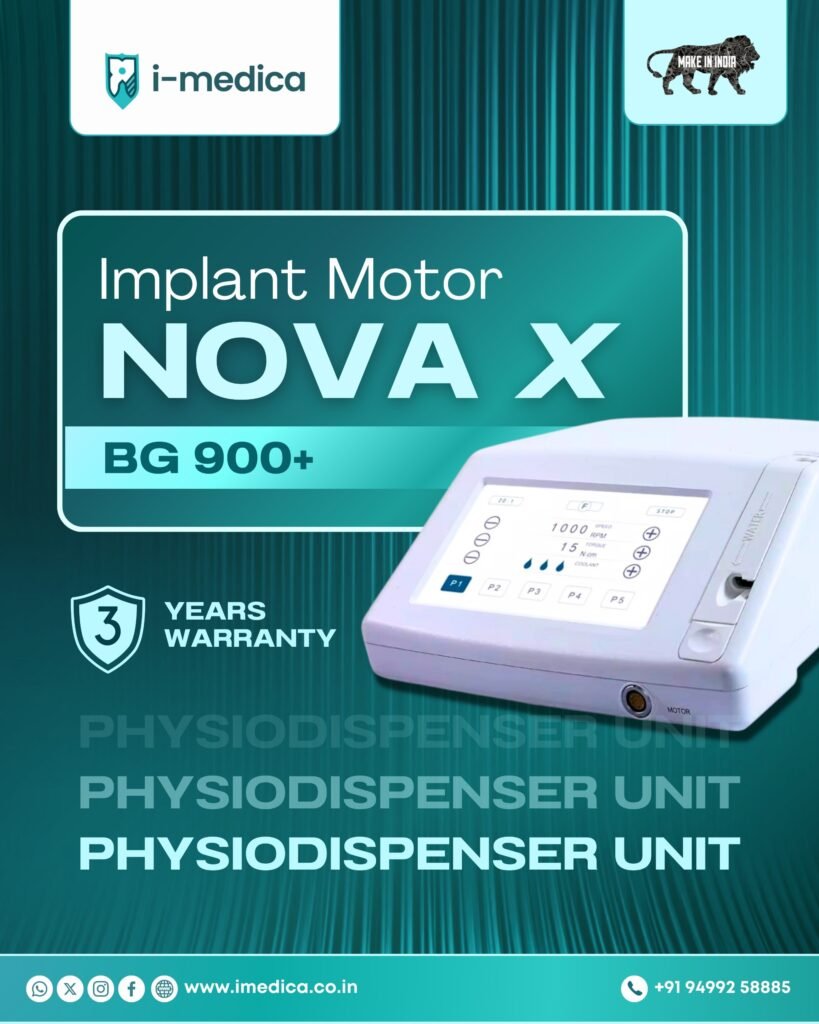
Dental Implant Motor NovaX BG-900+
- Post author:Imedica
- Post published:August 18, 2026
- Post category:Blog
- Post comments:0 Comments
Precision, control and confidence in modern implant dentistry
Dental implant surgery demands far more than rotational power. Every stage of an implant procedure—from the first osteotomy to final implant insertion—requires controlled speed, dependable torque and a clear understanding of how the instrument is responding. A purpose-built implant motor can help the clinician perform these steps with greater consistency while protecting the surgical workflow from avoidable interruptions.
The i-Medica NOVA X BG-900+ dental implant motor has been developed to support this need. Manufactured in India by i-Medica, it combines an ultra-smooth brushless DC motor, a fibre-optic surgical handpiece, a seven-inch touchscreen and programmable operating modes in one professional system. With a speed range extending from 200 to 40,000 rpm and controlled torque of up to 70 Ncm with a compatible 20:1 reduction handpiece, the unit is equipped for multiple stages of implant surgery.
For clinicians looking for a modern Made-in-India implant motor, the NOVA X BG-900+ offers a practical combination of performance, usability and local service support. It is designed not merely as another machine for the operatory, but as a reliable part of a repeatable implant workflow.
Why a dedicated dental implant motor matters
Implant osteotomy preparation is a controlled biological procedure. The clinician must prepare the site at an appropriate speed, apply torque carefully and maintain adequate irrigation. An ordinary dental micromotor is not designed to provide the same combination of low-speed control, high torque and programmable surgical settings required in implantology.
A dedicated dental implant motor allows the operator to select parameters according to the surgical step. Higher speed may be used during site preparation, while lower speed and controlled torque are important during tapping or implant insertion. The ability to configure and recall these values makes the workflow more organized and reduces the need for repeated manual adjustments.
The i-Medica NOVA X BG-900+ brings these functions together in a single interface. Its programmable memory settings help clinicians prepare modes for commonly repeated steps. This can improve consistency between procedures, particularly in practices where a defined drilling protocol is followed for different implant systems or bone conditions.
Ultra-smooth brushless DC motor performance
At the centre of the NOVA X BG-900+ is an ultra-smooth brushless DC motor. Brushless technology is especially valuable in surgical equipment because it supports stable rotation, efficient operation and reduced mechanical wear compared with traditional brushed designs. Smooth motor response can help the clinician maintain better control as load changes during drilling.
In implant surgery, stability is more meaningful than a high maximum figure alone. A motor must respond predictably across different stages of the procedure. From pilot drilling to enlargement of the osteotomy, reliable speed delivery helps the clinician work according to the selected protocol. During implant placement, controlled torque feedback assists in managing insertion without relying only on visual judgment or hand sensation.
The NOVA X BG-900+ provides a broad operating speed range of 200 to 40,000 rpm. This makes the system suitable for low-speed surgical functions as well as higher-speed drilling applications. When paired with the appropriate handpiece and bur, the clinician can configure the system for the task while retaining control through the touchscreen interface.
Accurate torque control up to 70 Ncm
Torque control is one of the most important characteristics of a professional implant motor. Excessive torque can place unnecessary stress on the implant, driver and surrounding bone. Insufficient torque may indicate inadequate primary stability or a mismatch between the prepared osteotomy and the clinical situation. Although the clinician must always interpret torque in the context of bone quality, implant design and the manufacturer’s protocol, dependable motor control provides valuable support.
With a compatible 20:1 reduction handpiece, the i-Medica dental implant motor delivers adjustable torque from 5 to 70 Ncm. This range gives the operator flexibility across drilling, tapping and implant insertion steps. Parameters can be selected according to the implant system and clinical plan rather than using one fixed setting throughout the procedure.
The purpose of torque control is not to replace clinical judgment. It is to make the selected protocol easier to execute consistently. The dentist remains responsible for assessing bone density, osteotomy preparation, implant position and primary stability. The NOVA X BG-900+ provides the controlled mechanical platform needed to translate that judgment into precise action.
Fibre-optic illumination for a clearer surgical field
Visibility is essential during implant surgery. Blood, irrigation and the limited access available in posterior areas can make the operative field difficult to observe. The NOVA X configuration includes fibre-optic illumination through the compatible optic motor and surgical handpiece, directing light close to the working area.
Illumination at the handpiece can support clearer observation of the osteotomy site, drill position and surrounding tissue. It may also reduce dependence on overhead lighting angles, especially when the clinician or assistant temporarily blocks the dental light. Better visibility supports confident instrument positioning and can make the overall workflow more comfortable for the surgical team.
For clinics comparing optic and non-optic implant motors, the difference is practical. An optic system integrates focused illumination into the handpiece assembly, keeping light aligned with the instrument. This is particularly useful for posterior implant sites, restricted mouth opening and procedures where precise angulation must be maintained.
Seven-inch touchscreen for intuitive operation
Advanced equipment should simplify the procedure rather than complicate it. The i-Medica NOVA X BG-900+ features a seven-inch LCD touchscreen that presents important operating parameters in a clear and accessible format. The clinician or assistant can review speed, torque, irrigation and program selection without navigating a confusing control panel.
The touchscreen supports quick adjustments before and during the surgical workflow. A clean visual interface can be especially helpful when the team is wearing gloves and needs to confirm the selected mode at a glance. By keeping key information visible, the system helps reduce uncertainty and promotes an organized operating sequence.
The unit provides at least five programmable settings, allowing frequently used combinations of speed, torque, direction and irrigation to be stored. A practice may configure separate programs for pilot drilling, sequential drilling, tapping, implant insertion and another preferred step. Exact settings should always follow the implant manufacturer’s instructions and the clinician’s assessment of the case.
Controlled irrigation for thermal management
Heat control is a fundamental consideration during osteotomy preparation. Friction between the rotating bur and bone can generate heat, particularly if the drill is worn, pressure is excessive or irrigation is inadequate. A reliable irrigation system helps flush debris from the site and supports thermal management during drilling.
The NOVA X BG-900+ incorporates an adjustable pump with an output range of approximately 40 to 100 ml per minute. This allows the surgical team to select the irrigation flow according to the bur, drilling stage and clinical preference. The system is designed to provide a steady supply of coolant through a properly installed irrigation line.
Irrigation performance must form part of a complete clinical protocol. The team should confirm flow before drilling, position the outlet correctly and monitor the site throughout the procedure. Tubing and sterile components should be installed according to the supplied instructions. Used together with sharp drills, intermittent drilling and controlled pressure, dependable irrigation can contribute to a safer and more efficient osteotomy workflow.
Auto thread-cutting function for advanced workflows
The NOVA X BG-900+ includes an auto thread-cutting function intended to support controlled preparation in selected implant workflows. Thread cutting or tapping may be recommended in dense bone or for particular implant designs. The correct decision depends on bone quality, implant geometry and the protocol provided by the implant manufacturer.
An automated mode can help standardize forward and reverse movement during this stage. It may reduce the need for repeated manual direction changes and allow the clinician to concentrate on instrument alignment and tactile feedback. This feature should be used only when appropriate for the case and after the operator understands the recommended settings.
By integrating advanced functions into programmable modes, the NOVA X BG-900+ gives experienced clinicians flexibility without forcing every procedure into the same sequence. The result is a platform that can adapt to different implant systems while preserving the operator’s control.
Designed to improve clinical workflow efficiency
Efficiency in implant dentistry is not simply about completing a procedure faster. It means reducing unnecessary steps, keeping the team coordinated and making important settings easy to reproduce. A well-organized implant motor can contribute to this efficiency in several ways.
First, saved programs reduce repeated parameter entry. Second, the large display makes settings easy for both the clinician and assistant to verify. Third, foot control allows essential functions to be operated without interrupting the sterile workflow. Finally, adjustable irrigation and a broad speed range keep multiple surgical stages within one coordinated system.
This combination is valuable for both established implant centres and clinics expanding their implant services. A dentist beginning a structured implantology workflow benefits from intuitive controls, while an experienced implantologist benefits from customizable settings and advanced operating modes.
Made in India with local support advantages
The growing demand for quality dental equipment in India has highlighted the importance of dependable domestic manufacturing. Imported machines can perform well, but service delays, spare-part availability and communication gaps may increase downtime. For a busy clinic, after-sales support is not a secondary consideration; it is part of the equipment’s long-term value.
The i-Medica NOVA X BG-900+ is made in India, giving Indian dentists access to a professional implant motor supported by a domestic manufacturer. Local communication can simplify product guidance, installation support, servicing and the supply of compatible accessories. It also allows clinics to build a direct relationship with a team that understands the Indian dental market.
Choosing Indian-made dental equipment also supports local technical capability and reduces unnecessary dependence on expensive imports. The relevant purchasing decision, however, should always consider the complete package: product performance, certification, warranty terms, training, maintenance requirements and availability of service. i-Medica’s aim is to combine modern functionality with responsive long-term support.
Important factors when choosing an implant motor
Before purchasing any dental implant motor, compare more than the headline torque value. Consider whether the machine provides stable low-speed operation, adequate maximum speed, programmable modes, adjustable irrigation and a compatible reduction handpiece. Review how clearly the screen displays parameters and whether the foot control is comfortable to use.
Also examine the practical ownership experience. Ask about warranty coverage, service turnaround, spare parts, handpiece maintenance and accessory availability. Confirm electrical compatibility for your clinic and understand which components are autoclavable. Verify the current regulatory and certification documentation directly with the supplier for the exact model being purchased.
The NOVA X BG-900+ addresses these decision points with a brushless motor, 200–40,000 rpm speed range, torque control up to 70 Ncm, fibre-optic capability, five or more programmable modes, adjustable irrigation and a seven-inch touchscreen. Together, these features create a balanced solution for modern implant practice.
A confident step toward smarter implant surgery
The best implant motor is not simply the one with the largest display or highest numerical specification. It is the one that helps the clinician carry out a carefully planned surgical protocol with control, visibility and consistency. The i-Medica NOVA X BG-900+ dental implant motor has been designed around these priorities.
Its ultra-smooth brushless DC motor supports stable operation. Torque control up to 70 Ncm assists with demanding low-speed procedures. Fibre-optic illumination improves visibility near the surgical site. The seven-inch touchscreen and programmable memory settings simplify workflow, while adjustable irrigation supports temperature management during osteotomy preparation. The auto thread-cutting function adds flexibility for appropriate advanced cases.
Most importantly, the NOVA X BG-900+ combines these capabilities with the accessibility of Indian manufacturing and local support. For dental professionals seeking to upgrade their implant setup, it represents a strong balance of technology, usability and practical ownership value.
To learn more about the i-Medica NOVA X BG-900+, request current specifications, confirm included accessories or arrange a product demonstration, visit www.imedica.co.in. Choose equipment that supports accurate planning, controlled execution and confidence in every implant case.
Product specifications, included accessories, warranty conditions and available configurations may change. Confirm the current details with i-Medica before purchase. This article is for product information and marketing purposes and does not replace professional training, clinical judgment or the implant manufacturer’s instructions.